
Mulching in Agriculture: A Practical Guide to Benefits and Methods
- Feb 26
- 5 min read
Updated: Mar 17
In the peak of summer, if you walk barefoot on a paved road, your feet burn. If you walk on bare soil, it’s just as hot. But if you step under the shade of a tree where leaves have fallen, the ground feels cool. This simple observation is the secret to Mulching- the single most powerful technique to amour your soil against the elements.
Most farmers focus on what happens above the ground (growth, pests, fruit size), but the real battle is won or lost in the top 6 inches of the soil. Mulching is the practice of covering this critical zone with organic or inorganic material. It is not an extra task; it is the foundation of modern, profitable farming.
1. The Science of the Skin: Why Mulch?
Think of your soil as the skin of your farm. If you leave it exposed to the sun, it gets sunburned. The UV rays kill the beneficial bacteria, and the heat evaporates every drop of moisture you’ve paid to pump into the field.
Moisture Conservation (The 50% Rule): When you irrigate bare soil, nearly 40-50% of that water is lost to evaporation before the plant can even drink it. Mulching creates a barrier that traps this moisture. In a world where water levels are dropping, a mulched farm can survive with half the water of a traditional farm.
Temperature Regulation: The roots of most crops (like tomatoes, chillies, or cucumbers) stop growing when the soil temperature crosses 30°C. In Indian summers, bare soil can easily hit 45°C. Mulching acts as insulation, keeping the root zone up to 10°C cooler in summer and warmer in winter. Consistent temperature means consistent growth.
2. Types of Mulching: Choosing Your Armour
There is no "one-size-fits-all" in mulching. Your choice depends on your crop, your budget, and your soil type.
A. Organic Mulching (The "Living" Choice)
Using straw, dried grass, sugarcane trash, or wood chips.
The Benefit: It doesn't just protect; it feeds. As organic mulch rots, it turns into humus, increasing your soil’s organic carbon.
Best For: Orchards (Mango, Pomegranate), long-duration crops, and farmers looking to improve soil structure over time.
The Catch: You need to ensure the material is free from weed seeds and pests like termites.
B. Plastic Mulching (The Professional Choice)
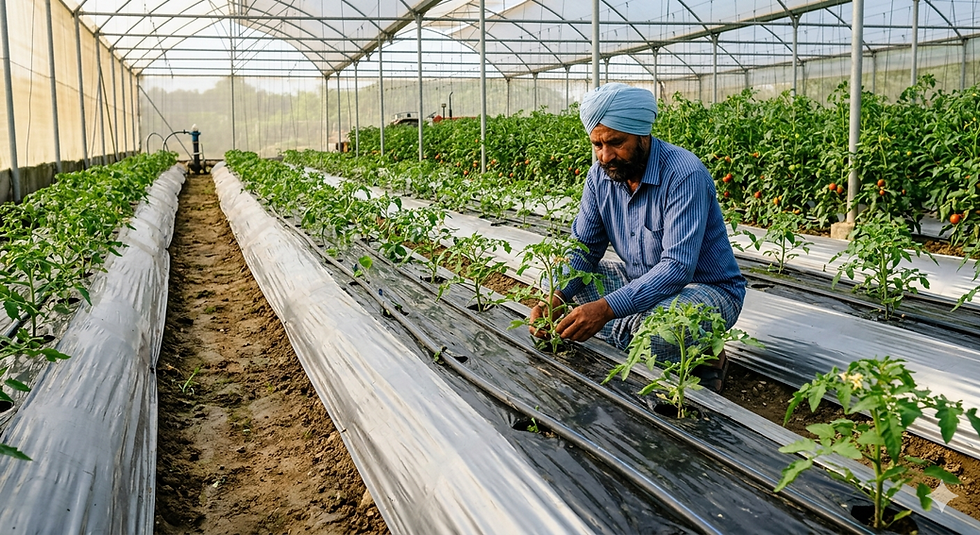
Using specialized polyethylene sheets (usually Silver-Black or Black-Black).
The Benefit: Total weed control. Because no light reaches the soil, weeds cannot grow. It also reflects light back onto the plant (Silver side up), which helps in photosynthesis and repels certain pests like thrips.
Best For: High-value vegetables (Capsicum, Strawberry, Melons) and drip-irrigated farms.
The Catch: It’s an upfront cost and requires proper disposal after the season to avoid plastic pollution.
3. The Economics: Spending to Save
Let's talk about the math. Many farmers avoid mulching because of the initial cost of the film or the labor of spreading straw. But look at the Hidden Profits:
Labor Savings: A typical 1-acre vegetable farm requires 3-4 rounds of manual weeding. At ₹4,000 per round, that’s ₹16,000. Plastic mulch eliminates 95% of this cost.
Fertilizer Efficiency: In bare soil, rain and irrigation leach fertilizers away. Under mulch, the fertilizer stays exactly where the roots are. You get more "output" from the same bag of DAP.
Market Premium: Mulched fruit doesn't touch the mud. Your tomatoes or melons come out clean, shiny, and free from soil-borne rots. In the Mandi, clean fruit always fetches a ₹2-5 premium per kg.
4. Step-by-Step: The Correct Method of Application
Success in mulching is all about the Setup.
Step 1: Soil Preparation
The soil must be at Vapsa condition (perfect moisture). If you apply mulch on dry, cloddy soil, you trap air pockets that can overheat the roots. The beds should be raised (1 foot high) to allow for drainage.
Step 2: Drip Installation
Never mulch without a drip system. Trying to flood-irrigate a mulched field is like trying to wash a car with the windows rolled up—the water never gets to where it’s needed.
Step 3: Laying the Sheet (For Plastic)
The sheet must be tight. If the plastic is loose, it will flap in the wind and act like a bellows, pumping hot air onto the plant stem, which causes collar rot. Bury the edges deep (at least 6 inches) into the soil.
Step 4: Creating the Holes
Don't just hack at the plastic with a knife. Use a heated pipe or a specialized hole-puncher to create clean, circular holes. This prevents the plastic from tearing further during the season.
5. Managing the Challenges
The Termite Factor: In organic mulching, if your soil is prone to termites, treat the straw with a biological agent like Metarhizium anisopliae or a light chemical drench before laying it down.
The Disposal Issue: For plastic mulch, never burn it in the field. The fumes are toxic to you and your soil. Many companies now offer Biodegradable Mulch Films that plow back into the earth, or you can sell the used plastic to recyclers.
The Field Report (Summary)
Mulching is the bridge between traditional kheti and precision farming. It is a one-time investment at the start of the season that pays you back every single day through saved water, saved labor, and better fruit quality. If you are using drip irrigation but not mulching, you are only doing half the job.
By covering the soil, you are protecting the home of your crop. A cool, moist, and weed-free home means a stress-free plant. And a stress-free plant is always a high-yielding plant.
Grower's Query Corner (FAQ)
Q.1 Which micron (thickness) should I use?
>For short-term vegetables (3-4 months), 20-25 microns is enough. For longer crops like Ginger or Turmeric, go for 30-40 microns so it doesn't degrade too early.
Q.2 Does the color of the plastic matter?
>Yes. Silver-Black is the gold standard- Silver reflects heat and repels pests, while Black keeps the soil dark to stop weeds. Yellow- Black is sometimes used in colder regions to attract more heat.
Q.3 Can I reuse plastic mulch?
>It is difficult because the holes won't match the next crop's spacing. However, some farmers use heavy 50-micron sheets in orchards for 2-3 years. Generally, for vegetables, a fresh sheet is recommended for disease control.
Q.4 Will mulching increase soil salinity?
>Actually, it helps. Evaporation brings salts to the surface. Since mulch stops evaporation, it helps keep salts distributed deeper in the soil, away from the sensitive root zone.
Visit agrijoy.in for more such updates.
Ready to embark on your hydroponic journey? Start today with Agri Joy—your partner in sustainable, Joyful farming!


Comments