
Bitter Gourd Production: Improving Vine Health, Flowering Efficiency, and Fruit Quality Through Better Crop Management
- May 16
- 6 min read
Updated: May 18
Bitter gourd production requires careful management of irrigation, nutrition, vine growth, and pollination throughout the crop cycle. A well-managed crop not only improves yield consistency but also supports better fruit quality and market value under varying field conditions.
Bitter gourd, also known as bitter melon, is widely cultivated across tropical and subtropical regions because of its nutritional value, medicinal importance, and strong market demand. However, despite its commercial potential, many farmers struggle to maintain stable productivity throughout the season
In many cases, the crop initially appears healthy, but productivity gradually drops due to imbalance between vegetative growth and reproductive development.
Successful bitter gourd farming depends less on heavy intervention and more on maintaining crop balance at every stage of growth.
📲 Connect with us on WhatsApp for practical guidance on bitter gourd cultivation, irrigation planning, flowering management, and improving overall crop productivity.
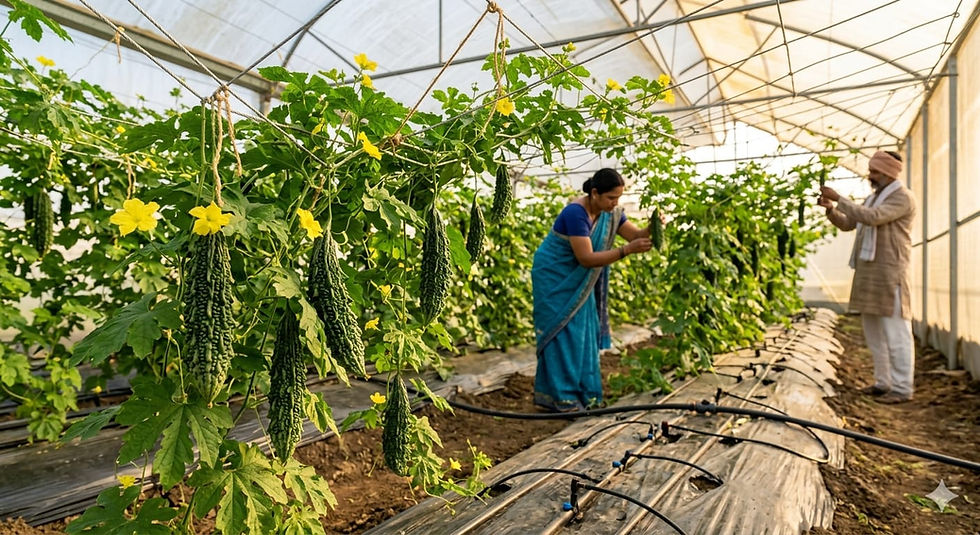
1. Understanding Bitter Gourd Crop Behavior
Bitter gourd is a fast-growing climbing vegetable crop that responds strongly to environmental conditions and management practices.
The crop mainly focuses on:
• Rapid vine development
• Continuous flowering
• Repeated fruit production
• High nutrient demand during active growth
Because of this vigorous growth pattern, even small management mistakes can influence flowering and fruit quality significantly.
The crop performs best under warm temperatures, good sunlight exposure, and proper moisture management.
2. Importance of Soil Preparation and Field Structure
Crop performance begins with healthy root establishment.
Since bitter gourd develops an active root system, soil condition directly affects:
• Nutrient absorption
• Water availability
• Root aeration
• Plant vigor
Ideal Field Characteristics
• Well-drained loamy soil
• Good organic matter content
• Proper sunlight exposure
• Balanced moisture retention
Water stagnation should be avoided because it increases disease pressure and weakens root activity.
Many farmers now integrate raised bed cultivation with mulching systems to improve drainage and moisture stability.
3. Trellis Management and Vine Control
Bitter gourd performs significantly better when vines are properly supported.
Modern cultivation increasingly depends on trellis systems because they improve:
• Air circulation
• Sunlight penetration
• Pollination efficiency
• Fruit quality
• Ease of harvesting
Without proper support systems, vines often become overcrowded, increasing humidity and disease risk.
Benefits of Trellis-Based Production
Improved Fruit Development
Fruits grow straighter and more uniformly.
Better Disease Management
Open vine structure reduces moisture accumulation.
Easier Field Monitoring
Farmers can identify pest and disease problems earlier.
Improved Harvesting Efficiency
Fruits become easier to locate and harvest.
4. Moisture Management and Irrigation Planning
Water management strongly influences flowering and fruit production in bitter gourd cultivation.
The crop requires stable moisture, especially during:
• Flowering stage
• Fruit initiation stage
• Peak fruit development period
However, excessive irrigation can create problems such as:
• Root stress
• Nutrient leaching
• Increased fungal pressure
• Reduced oxygen availability in soil
Instead of irregular heavy irrigation, maintaining balanced soil moisture is generally more effective.
Recommended Irrigation Practices
• Frequent light irrigation
• Drip irrigation systems
• Mulching for moisture conservation
• Irrigation during cooler periods of the day
According to the Food and Agriculture Organization (FAO), drip irrigation combined with mulching significantly improves water-use efficiency in vegetable production systems.
5. Flowering and Pollination Efficiency
One of the most critical aspects of bitter gourd production is maintaining proper flowering balance.
The crop produces both male and female flowers, but fruit production depends heavily on successful pollination.
Common Flowering Issues
• Low female flower ratio
• Flower drop
• Weak pollination activity
• Poor fruit setting under stress conditions
Environmental stress, nutrient imbalance, and moisture fluctuations often reduce reproductive performance.
To improve flowering efficiency, farmers should focus on:
• Maintaining stable crop growth
• Avoiding excessive nitrogen application
• Supporting pollinator activity
• Reducing heat and moisture stress
Balanced crop growth usually supports better reproductive performance naturally.
6. Heat Stress and Seasonal Challenges
Bitter gourd performs well under warm weather, but excessive temperature stress can still reduce productivity.
High heat conditions may lead to:
• Reduced flowering
• Weak fruit setting
• Faster moisture loss
• Reduced fruit quality
Managing crop stress becomes increasingly important during peak summer conditions.
Practical Stress Reduction Methods
>Mulching
Mulching helps:
• Maintain soil temperature
• Reduce evaporation losses
• Suppress weed growth
• Improve moisture consistency
>Timely Irrigation
Consistent irrigation reduces plant stress during hot periods.
>Balanced Nutrient Supply
Healthy plants tolerate environmental stress more efficiently.
7. Nutrient Management for Sustainable Production
Bitter gourd is a nutrient-responsive crop.
Poor nutrient management often results in:
• Excessive vine growth
• Delayed fruiting
• Weak fruit development
• Lower harvest consistency
Nutrient management should support balanced crop growth rather than excessive vegetative expansion.
Key Nutrient Functions
>Nitrogen
Supports early vine development.
>Phosphorus
Improves root establishment and flowering.
>Potassium
Supports fruit growth and overall crop strength.
>Micronutrients
Improve stress tolerance and reproductive performance.
Split nutrient application often improves nutrient-use efficiency and reduces wastage.
8. Pest and Disease Management in Bitter Gourd Farming
Dense vine growth creates favorable conditions for several pests and diseases.
Common Pest Problems
• Fruit fly
• Aphids
• Whiteflies
• Leaf-feeding caterpillars
Common Disease Issues
• Powdery mildew
• Downy mildew
• Mosaic virus
• Leaf spot diseases
Practical Crop Protection Strategies
• Regular field inspection
• Proper vine spacing
• Controlled humidity around foliage
• Removal of infected material
• Preventive management approaches
According to the Indian Institute of Vegetable Research (IIVR), preventive crop monitoring remains one of the most effective approaches for reducing production losses in cucurbit cultivation.
9. Harvesting Management and Production Continuity
Bitter gourd is a continuous harvesting crop.
Delayed harvesting often leads to:
• Reduced fruit tenderness
• Declining market quality
• Lower future fruit production
Timely harvesting helps maintain continuous flowering and productive crop cycles.
Farmers generally achieve better market value when fruits are harvested at proper maturity stages.
10. Post-Harvest Quality and Market Performance
Market acceptance depends heavily on fruit appearance and freshness.
Important quality factors include:
• Uniform fruit size
• Proper color development
• Tender texture
• Minimal physical damage
Careful handling during harvesting and transportation improves shelf life and market value.
11. Economic Importance of Efficient Crop Management
Profitability in bitter gourd farming depends on maintaining production consistency rather than relying only on peak yield.
Efficient management helps farmers improve:
• Harvest duration
• Fruit quality
• Resource efficiency
• Marketable production
Reducing crop stress and maintaining stable productivity often improves long-term returns more effectively than excessive input use.
12. Sustainable Approaches in Bitter Gourd Production
Modern vegetable cultivation increasingly focuses on resource-efficient farming systems.
Important sustainability practices include:
• Drip irrigation systems
• Mulching
• Efficient nutrient application
• Integrated pest management
• Trellis cultivation
These practices support both productivity and long-term soil and water conservation.
Building a More Stable Bitter Gourd Farming System
Successful bitter gourd production requires regular observation and timely adjustments throughout the crop cycle.
Farmers should consistently monitor:
• Moisture conditions
• Flowering behavior
• Vine density
• Pest activity
• Fruit development
Field-level management decisions made at the right time usually create the biggest impact on final productivity and quality.
Agri Joy supports farmers through practical cultivation guidance focused on improving vegetable crop management under real farming conditions.
Final Farming Insights
Bitter gourd production offers strong commercial potential when managed systematically.
The crop requires balanced irrigation, healthy flowering conditions, proper vine support, and consistent harvesting management to maintain productivity throughout the season.
In vegetable farming, sustainable productivity often depends on disciplined crop management rather than occasional corrective action.
Common Farmer Questions (FAQs)
1.Why is trellis support important in bitter gourd farming?
> It improves airflow, fruit quality, sunlight exposure, and harvesting efficiency.
2.What causes flower drop in bitter gourd?
> Usually stress conditions, nutrient imbalance, or moisture fluctuations.
3.Does drip irrigation help in bitter gourd production?
> Yes, it improves moisture consistency and water-use efficiency.
4.Why does fruit quality decline during the season?
> Often due to irregular harvesting, stress, or improper crop balance.
📲 Fill out the form below to receive customized recommendations for better bitter gourd production, nutrient management, and efficient crop planning based on your farm conditions.
Visit agrijoy.in for more such updates.
Ready to embark on your hydroponic journey? Start today with Agri Joy—your partner in sustainable, Joyful farming


Comments