
Hydroponics vs Traditional Farming: Which Is More Profitable in India?

The Indian agriculture industry is currently undergoing a massive change. Due to rising water scarcity, unpredictable weather patterns, rising labour costs and less available agricultural land, farmers are looking at more innovative ways to increase their productivity and profit. One way that is becoming popular is using hydroponics farming.
Traditional farming, however, is still widely used in India due to it being affordable and accessible.
Hydroponics vs Traditional Farming: Which Is More Profitable in India?
In this write-up, we will discuss the differences between both of these methods of farming. In addition to it, we’ll look at various aspects such as initial investment, running costs, yield, water usage, demand and overall profitability to give farmers and agripreneurs an idea of which would be best for them. But before checking out the blog, explore some of the important points related to Hydroponic.
Key Points
If set up correctly, you can save up to 90% of water.
Certain crops can be grown with higher yields per square foot.
Traditional farming methods do not require as much technical maintenance.
Hydroponics can lead to greater profits as they can grow high value premium crops.
Overall it depends on your budget, type of crops being grown, market demand and farming conditions to determine which option will give you more profit.
What Is Hydroponics Farming?
Interesting Fact: Hydroponic farming can use up to 90% less water than traditional soil-based farming by recycling nutrient-rich water, making it a sustainable option for agriculture in India.
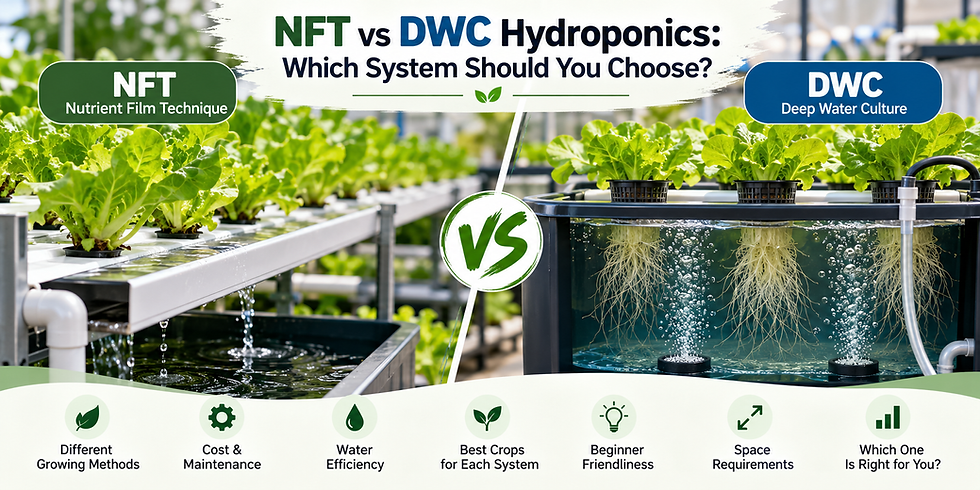
Hydroponics is a modern farming system. In this system, crops are grown without using any soil. Plants are provided with all vital nutrients using a special solution of water.
Hydroponic farming systems can easily be set up in greenhouses, polyhouses or farming buildings.
Some popular crops that can be grown using hydroponics in India are:
Lettuce and leafy greens
Spinach and kale
Basil, mint and other herbs
Cherry tomatoes
Cucumber
Strawberry
A huge benefit of hydroponic farming is that you can grow high value crops on little land and with little water. This makes it very popular for farming in urban areas.
What Is Traditional Farming?
Traditional farming is when crops are grown in the soil. The crops are farmed using traditional farming methods like ploughing, planting, watering, fertilizing and harvesting.
Traditional farming is widely used in India to grow wheat, rice, sugarcane, pulses, vegetables and fruits.
The biggest benefit of traditional farming is that you can farm on your already existing farmland using traditional farming techniques, without investing much money into setting up a more advanced system.
Traditional agriculture can often be affected by changes in monsoons, poor quality soil, pests and changes in market prices.
Key Differences between Hydroponic & Traditional Farming
Factors | Hydroponic Farming | Traditional Farming |
Growing medium | Nutrient-rich water | Soil |
Initial investment | High | Usually lower |
Water consumption | Generally much lower | Usually higher |
Crop growth | Often faster for suitable crops | Depends on crop and season |
Land requirement | Compact and space-efficient | Generally more land-intensive |
Weather dependency | Lower in protected systems | Often higher |
Both farming methods have unique advantages. Their profitability depends on the crops selected, available capital, operating expenses, and access to customers.
Initial Investment: Which Farming Method Costs More?
This is one of the most significant differences between hydroponics and traditional farming.
Investment required in Hydroponics farming:
Hydroponics farming requires specific equipment such as growing channels, nutrient tanks, water pumps, filters, monitoring instruments and also climate control equipment.
A commercial system of about 1000 square feet would require an investment of around Rs. 3-10 lakhs (indicative figure) to set up. The amount will depend on how automated your system is, the infrastructure and how much climate control you have.
Climate controlled systems can be much more expensive.
Investment required in traditional farming:
Traditional farming does not require as much specialist infrastructure, especially if you have access to good ground and irrigation equipment.
The main costs will be seeds, fertilizers, labour, irrigation, pesticides and machinery.
However, if you need to buy land/borewell etc. plus tractors and other infrastructure then this can increase the overall cost.
Verdict: Traditional farming methods will be cheaper to get started whereas hydroponics will require a higher initial investment.
2. Crop Yield and Productivity
Crop production will greatly affect your profitability.
Hydroponics gives you greater control over nutrients, water and growing conditions. If you choose suitable crops this can help them grow faster and produce consistently.
Hydroponic systems can give you more growing cycles throughout the year.
Traditional farming will depend on ground fertility, seasons, irrigation and pests.
Traditional farming is very productive however it can still be economical for larger scale crops like wheat, rice and pulses.
Verdict: Hydroponics can give you a better production per square metre for certain vegetables and leafy greens but will not always be more productive or economical for all crops.
3. Water Usage
Water is becoming a problem in several areas within Agriculture in India.
Hydroponics is an effective way to save water as it re-circulates the water containing nutrients.
If well managed a hydroponic system can cut down on the amount of water you are using by up to 80-90% when compared to soil based cultivation.
Traditional methods will use quite a lot of water for irrigation purposes due to evaporation.
However, if drip irrigation, mulching and better water management techniques are used, soil based agriculture can be very efficient.
Verdict: Hydroponics will generally be more efficient with water usage, especially in areas where water may be scarce.
4. Costs
Although hydroponics can be an effective way to save water and provide more consistent growth there are regular costs involved.
Electricity, nutrients, water testing maintenance, skilled labour and replacements will need to be considered.
Cooling and ventilation can be expensive in climate controlled environments during the hot summers in India.
Traditional agriculture will regularly involve costs such as buying seeds, fertilizers, irrigation, labour, machinery and crop protection.
Depending on the crop, size of farm and methods used the costs can vary greatly.
Verdict: Traditional farming may have fewer technical maintenance costs; however, hydroponics will need to be carefully managed to ensure they are making a profit.
5. Market and Price
Having a good market is key to making a profit from your crops.
Hydroponics are a great option for high value crops such as vegetables, exotic leafy greens and herbs which can be sold to supermarkets, restaurants, hotels and urban areas.
There are many markets in cities such as Delhi NCR, Mumbai, Bengaluru, Hyderabad and Pune.
However, just because you are using hydroponics to grow your crops doesn’t mean that you will get a premium price for them. You need to have buyers who are willing to pay more to cover the increased costs.
Traditional farming will have a much larger market.
Verdict: Hydroponics may give you more income from your premium crops, however traditional farming will have a larger market.
6. Profitability
Let’s assume we have a 1000ft² of area to grow our leafy vegetables.
Hydroponics may allow you to make between ₹4-7lakh per year however you will need to take into consideration the costs of electricity, labour, nutrients, packaging, transportation, maintenance and depreciation.
Using traditional soil based methods you may have a smaller initial investment however you may not make as much money per year depending on the crop cycle, yields and price.
These are just example numbers. There are not confirmed average returns for farms in India. You can see how the numbers can vary.
The basic formula is:
Net Profit = Total Income – Total Costs – Depreciation, Finance and Other Costs.
Farmers should also consider their Return on Investment, Cash Flow, Crop Loss and Break Even Point.
More income doesn’t always mean more profit.
Which Farming Method Is Better For Indian Farmers?
Hydroponics can be a great option if you have enough funds, technical knowledge, good access to electricity and high-end urban markets. This method will give great results if you want to grow leafy herbs and plants commercially.
Traditional farming would be a good option if growing staple crops, on larger plots of land or if you have limited funds.
Many Indian farmers may find that improving their traditional farming practices by using drip irrigation, soil tests, protected growing and improving market access will give better financial returns.
Conclusion
Is Hydroponics Farming More Profitable In India?
It really depends on your funding, what crops you are trying to grow, how efficient your growing is and what market you have.
Hydroponics can provide great opportunities to save on water usage, grow intensively and gain access to high-end vegetable markets. However, the increased start-up and running costs can pose a risk to your finances.
Traditional farming can be easier to get into, especially if growing staple crops.
Ultimately, the most profitable way to farm will be the one that has consistent profit once all costs have been deducted.
Before investing into hydroponics farming, it is best to carry out some research to make sure it is feasible, find out potential buyers and ideally start small.
Frequently Asked Questions (FAQ’s)
1. Is hydroponic farming more profitable than traditional farming in India?
This can be the case if you can grow high value crops such as lettuce, basil and exotic vegetables and sell them to reliable high-end buyers. However, the increased infrastructure and running costs can decrease your profitability. Traditional farming may give better returns if growing staple crops and with limited funds.
2. How much investment is needed to start hydroponic farming in India?
A commercial 1000 square foot hydroponic set up can range from around ₹3-10lakh plus. This depends on what type of system you are using and how automated you want it to be. You should also consider how you are going to grow your plants and if you need climate control. It is best to get some quotes locally and create an in-depth business plan.
3. What crops are the most profitable to grow using hydroponics in India?
Some crops that can be profitable to grow using hydroponics include lettuce, basil, kale, spinach, mint, cherry tomatoes and cucumbers. This will depend on what is in demand locally, your costs to produce, quality and selling price. Leafy crops and herbs are often a good place to start.
4. Will hydroponics farming replace traditional farming in India?
Unlikely. Hydroponics is a great option to grow certain vegetables and herbs, however traditional soil farming is very important for growing high volumes of cereals, pulses, oil seeds and many other crops. Both could work well together in the future of farming in India.


Comments